태초에 세상이 어떻게 만들어졌는지 알고 싶다면If You Want to Know How the World Was Made in the Beginning
그러나 천지의 혼돈이 아직 완전히 바로잡힌 것은 아니었다. 하늘에는 해도 둘, 달도 둘이 떠 있으므로, 낮에는 만민 백성들이 더워 죽게 마련이고, 밤에는 추워 죽게 마련이었다. 그뿐 아니라, 이때는 모든 초목이나 새·짐승들이 말을 하고, 귀신과 인간의 구별이 없어 사람 불러 귀신이 대답하고, 귀신 불러 사람이 대답하는, 그야말로 혼잡한 판국이었다.But the chaos of heaven and earth had not yet been fully set right. There were two suns and two moons in the sky, so by day all the people were bound to die of heat, and by night, of cold. Not only that, but in those days all the plants, birds, and beasts could speak, and there was no distinction between ghosts and humans: call for a person and a ghost would answer; call for a ghost and a person would answer. It was, truly, a world in utter confusion.
우연히 접하게 된 책A Book I Stumbled Upon
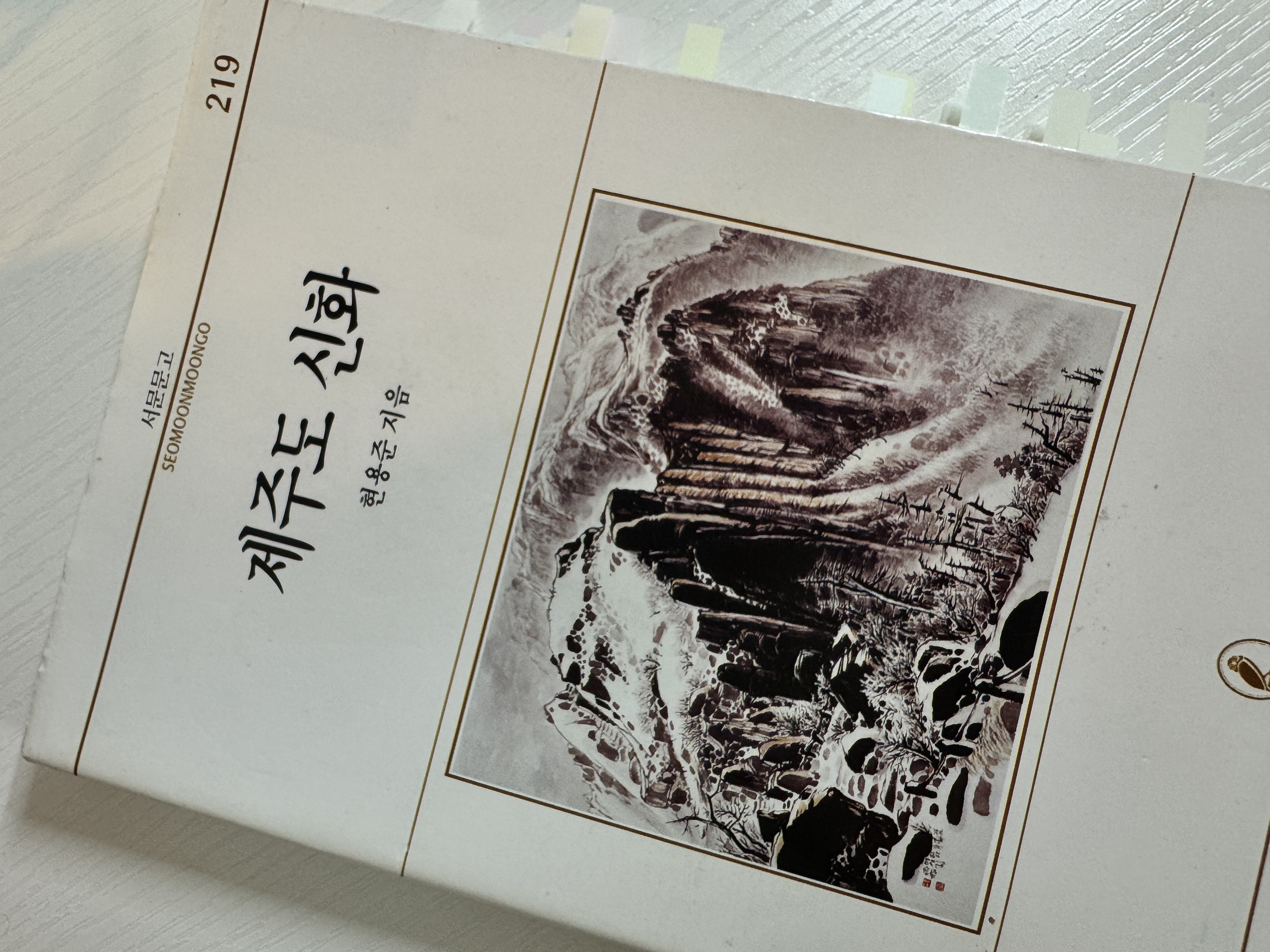
교환독서에서 읽을 책을 사기 위해 투카인드북스에 갔다. 서점 밖에 중고 책들이 몇 권 나와있었고 중고책이라기보다는 관리가 잘 된 오래된 책들처럼 보였다.(독후감을 쓰다가 알았는데, 알고보니 애초에 중고책이 아니었다.) 그 중에 제주도 신화라는 책의 제목이 눈에 띄었다. 이 책은 서점에 들리기 전 서점 인스타그램의 오랜 게시물에서 보았던 책이라 아직 있을 거라고 예상하지 못했다. 피드를 보면서도 이 책은 제주도에 머뭄을 기념하기에 좋은 책이라 생각했다. 다만 이미 한강 작가의 작별하지 않는다로 제주를 기념하려 했기에 일단은 집어들지 않고 서점 안으로 들어갔다. 서점에 있는 거의 모든 책을 훑고 나서 한 권을 고른 후 계산을 할 때까지만 해도 제주도 신화 책을 구입할 생각은 없었다고 말할 수 있다. 계산하는데 갑자기 '잠시만요'라는 말이 튕나왔고, 밖을 나와 책을 집은 후 같이 계산을 요청드렸다. 5천원은 기념품 값으로 지불하기에 나쁘지 않다고 생각했기에 충동구매를 한거다. 밖에 서성이며 책을 잠깐 보았을 때 한자에, 이제는 안 쓰이는 고어들이 난무해서 내가 읽게 될 거라고는 생각하지 않았다.I went to Two Kind Books to buy a book for a book swap. There were a few books set out in front of the shop, and rather than used books, they looked like old books that had been well cared for. (I found this out while writing the review, but apparently they weren’t used books in the first place.) Among them, a title caught my eye: Myths of Jeju Island. I’d seen this book in an old post on the bookstore’s Instagram before visiting, so I hadn’t expected it would still be there. Even while looking through the feed, I’d thought it would make a nice book to commemorate my stay on Jeju. But I was already planning to commemorate Jeju with Han Kang’s We Do Not Part, so I left it there for the moment and went inside. I can honestly say that even after browsing almost every book in the shop, choosing one, and going up to pay, I still had no intention of buying Myths of Jeju Island. Then, in the middle of checking out, “Wait just a second” suddenly popped out of my mouth. I went back outside, picked up the book, and asked them to ring it up too. I thought 5,000 won wasn’t a bad price for a souvenir, so yes, it was an impulse buy. When I’d stood outside flipping through it for a moment, it was full of Chinese characters and archaic words no one uses anymore, so I never imagined I’d actually read it.
빠져드는 천치창조 이야기A Creation Story That Pulls You In
교환독서를 위해 산 나의 통역사 책을 만 하루가 안 되어 다 읽고, 처음으로 주석을 달면서 읽어보니 그 재미에 흠뻑 빠져서 다른 책을 또 읽고 싶었다. 원래 평소 하던대로 이북을 읽으면 됐는데 어쩐일인지 내 손은 이 책을 펼쳤다. (나만 보는 블로그지만 공개가 되어있어서 약간 말을 꺼내기 불편하긴 하지만)천지창조하는 이야기로 포문을 열었다. 더 읽으니 제주도민이 아닌 나에게도 익숙한(그리고 예상했던) 설문할망의 이야기도 나왔다. 낯선 말투지만 쉽게 읽혔고, 금방 몰입되게 하는 이야기가 전개되었다. 오래된 책이다보니 쉽게 구하기 어려울 거라고 생각해서 초반에 책을 아껴보느라 코멘트를 안 달고 읽은게 아쉽다. (알고보니 온라인에서 4,500원에 팔고 있었다ㅠㅋㅋ)I finished The Interpreter, the book I’d bought for the book swap, in less than a full day. It was my first time reading while adding notes, and I got so completely hooked on the fun of it that I wanted to read another book. I could’ve just read an ebook like I usually do, but for some reason my hands opened this one instead. (This is a blog only I read, but it is public, so it feels a little awkward to bring this up.) It opened with the creation of heaven and earth. As I read on, the story of Grandmother Seolmundae appeared too—familiar even to me, a non-Jeju islander (and just as I’d expected). The language was unfamiliar, but easy to read, and the story drew me in almost immediately. Because it was an old book, I assumed it would be hard to find, and I regret reading the beginning without leaving any comments because I was trying to preserve it. (Turns out it was being sold online for 4,500 won 😭 lol.)
자랑스러운 우리의 창조신화Our Creation Myth, and One to Be Proud Of
교환독서모임에서 정식 모임은 아니지만 카페에서 잠깐 만나서 책 교환을 하는 모임이 있어 참여했다. 내가 산 책을 소개하는데 한 분이 이 책에 관심을 갖고 찜해두셔서 그때부터 포스트잇 등으로 간단하게 주석을 남기며 읽었다. 처음에는 이런 책은 독서모임에 들고가기는 커녕 나도 흥미를 안 붙일거라고 생각했는데 이렇게나 재미있는 책일 줄이야..? 읽는 중에 간드락 공유 카페에서 읽은 '제주역사기행'(이영권 지음)을 읽는데 이 책에서 읽은 신화 이야기가 짧게 소개되었다. 재밌게 읽은 신화와 실제로 관련있는 지역을 같이 설명하는 책을 읽으니 그 재미가 배로 늘었음은 물론이고, 제주에는 1만 8천 신들이 있고, 전세계적으로 흔치 않은 천지창조 신화 중 하나라는 걸 알게 되었다. 어쩐지 읽을 때 나도 모르게 내가 알고 있는 또 다른 창조신화 - 성경과 비교 대조를 하면서 읽었다. 그리고 꽤나 놀라울 정도로 공통점이 많다.There’s an unofficial little meetup for the book-swap group where we briefly meet at a café to exchange our books, and I joined in. While I was introducing the book I’d bought, someone took an interest in it and claimed it for later, so from then on I read while leaving brief notes on Post-its and things. At first, I thought this was the kind of book I’d never bring to a book club—never mind actually get interested in myself—but who knew it would be this much fun...? While I was reading it, I also read A Journey Through Jeju’s History by Lee Young-kwon at the Gandrak shared café, and that book briefly introduced one of the myths I’d read here. Reading a book that explained the real places connected to a myth I’d enjoyed obviously doubled the fun, and I also learned that Jeju has eighteen thousand gods, and that this is one of the world’s relatively rare creation myths. Maybe that’s why, as I read, I found myself unconsciously comparing and contrasting it with another creation myth I know: the Bible. And they have a surprisingly large number of things in common.
그 시대의 우리 이야기Our Stories from That Time
이 책의 저자 현용주 교수가 말하길 이 책이 세상에 나올 때는(초판 인쇄 1972년) '신화'라는 용어가 외국에서 도입된 것이어서 아직까지 시골사람들이나 무당들은 알지 못한다 했다. 이 신화들이 구전될 때는 훨씬 더 과거이니 지금의 문화나 정서와는 매우 달랐다. 1. 총 26개의 신화가 실렸는데 대부분(내가 기억하기로는 전부) 가족이 엮인 이야기다. 좀 더 자세히 구체화하자면 번성을 위하여 자식을 낳아야 하는 이야기, 혹은 그런 자식이 자산 증식에 득이 되지 않아 갖다 버리는 이야기. 여기에서 자식은 지금의 보편적인 개념의 '자식'과 '재산' 사이의 범주에 놓여있다. 그래서 그 재산이 더 이상 부를 가져다 주지 않으면 버리거나 죽이기 쉽다. 새로 들이면 되니까. 2. 남존여비는 말할 것도 없다. 오랜 시간이 지나도 자식이 없는 부부가 열심히 기도를 하지만 딱 1%씩만 부족해서 아들이 아닌 딸을 가진다. 남편은 어리석지만 권력과 권리를 가졌다. 중들은 아무 여자나 임신시키고 사라진다. 아이러니하게도 신화 속 남자들은 어리석고 여자는 현명하게 많이 그려졌다. 당연하게도 결국 조명을 받는 건 어리석은 남자들이다. 3. 그 시대를 보여주는 것들 중 또다른 하나는 사지를 마소에 묶어 찢거나, 갈기갈기 먼지처럼 찢어발기거나 하는 식의 죽음이 많다. 구전되어 왔기 때문에 여러 신화에 겹치는 부분이 많다. 하필 그런 부분 직전에서 읽기를 멈추고 다시 시작하면 읽었던 부분이라고 착각하기 쉽다. 그 후 다른 전개와 결말에 오히려 어떻게 구전되며 이야기가 다양해졌을지 생각하며 읽으니 책 읽는 재미가 배가 됐다. 눈에 띄는 점은 - 형제자매가 얼마나 많든 막내들을 영리하고 현명하게 묘사한다. - 별의 별 사람이 신이되고, 별의 별 종류의 신이 많다. 이건 어떤 문화나 시대상이 반영되었는지 궁금하다. 신들이 인간적으로 묘사되는 것이 성경보다는 고대 이집트 신화나 그리스로마 신화에 가깝다.According to Professor Hyun Yong-ju, the author of this book, when it first came out (the first edition was printed in 1972), the term “myth” had been imported from abroad and was still unknown to country people and shamans. These myths were passed down orally from a much earlier time, so their culture and sensibilities were very different from ours today. 1. The book contains twenty-six myths in all, and most of them (all of them, as far as I remember) revolve around family. To be more specific: stories about needing to have children so the family can prosper, or stories about throwing those children away when they’re no help in growing the family’s assets. Here, children fall somewhere between our usual modern ideas of “children” and “property.” So once that property stops bringing in wealth, it’s easy to abandon or kill it. You can always acquire another one. 2. The preference for men over women goes without saying. A childless couple prays fervently after many long years, but because each of them is short by just one percent, they have a daughter instead of a son. The husband is foolish, but he has power and rights. Monks get any woman they please pregnant, then disappear. Ironically, the men in these myths are often portrayed as foolish and the women as wise. Naturally, in the end, it’s the foolish men who get the spotlight. 3. Another thing that shows the era: there are many deaths involving someone’s four limbs being tied to horses or cattle and torn apart, or their body being ripped to shreds, torn as fine as dust. Because the stories were passed down orally, many of the myths overlap. If you happen to stop reading right before one of those parts and pick the book up again later, it’s easy to think you’ve already read it. But then the plot and ending veer off in another direction. Once I started reading while imagining how oral retellings might have made the stories branch out in different ways, the book became twice as much fun. A few things that stood out: - No matter how many siblings there are, the youngest are portrayed as clever and wise. - Every imaginable kind of person becomes a god, and there are every imaginable kind of god. I’m curious what sort of culture or period these details reflect. The gods are portrayed in such human terms that they feel closer to ancient Egyptian or Greco-Roman mythology than to the Bible.
무당들의 필독서Required Reading for Shamans
가끔 무당들은 어떻게 공부하고 계승해올까 궁금해했는데 이 책을 읽으면서 이게 무당들의 필독서겠구나 하는 생각이 들었다.(제주 무당(심방) 한정일 수 있겠지만) 실제로 신화마다 어떤 무당의 구연에서 가져왔는지, 이게 어떤 굿의 이야기인지 명시되어 있다. 그래서 그냥 내멋대로 무당 필독서라고 생각하고 재밌게 읽었다. 제주도 신들 때문에 오늘 날 우리 삶에 영향끼치는 것들이 많은데 몇 가지만 소개해본다. - 강님(남자)이 이승으로 돌아올 때 흰 강아지가 목덜미를 물었기 때문에 여자에게는 없으나 남자에게는 목젖이 생겼다. - 살아있을 때 남들 피 빨아먹으며 살던 과양생 부부는 죽어서도 모기가 되어 남들 피를 빨아먹으려 달겨든다. - 까마귀가 죽음의 법을 적은 적패지를 잃어버려서 사람들의 죽음의 순서가 뒤죽박죽 되어버렸다. - 자청비가 개미 허리를 발로 밟아서 개미 허리는 홀쭉하게 가느다랗게 되었다.Sometimes I’ve wondered how shamans study and pass their traditions down, and while reading this book I found myself thinking, Ah, this must be required reading for shamans. (Though maybe only for Jeju shamans, or simbang.) For every myth, the book actually specifies which shaman’s oral performance it came from and which gut ritual the story belongs to. So I just decided, entirely on my own, that this was required reading for shamans and had a great time with it. The gods of Jeju are responsible for quite a few things that still affect our lives today. Here are just a few: - When Gangnim (a man) returned to this world, a white puppy bit the back of his neck, which is why men have Adam’s apples and women do not. - The Gwayangsaeng couple lived by sucking other people’s blood while they were alive, and even after death they became mosquitoes, rushing at people to suck their blood. - A crow lost the red tablet bearing the law of death, so the order in which people die became all jumbled up. - Jacheongbi stepped on an ant’s waist, which is why ants have such slim, narrow waists.
원조 텔레노벨라The Original Telenovela
읽다보면 성균관 스캔들이 있고, 천국의 계단이 있고, 구미호 외전이 있고, 커피프린스 이야기에 전청조 이야기도 있고 그렇다. 도파민 터지는 이야기는 다 모아놨다. 이렇게 다양한 미디어가 넘쳐나는 시대에서 태어난 나도 전혀 예상할 수 없는 전개들에 무척 재밌게 읽었는데 그때 당시에는 얼마나 재미있었을까..! (혹은 두려웠을까/교육적이었을까는 모르겠지만. 기독교인이 성경을 읽는 느낌, 무슬림이 코란을 읽는 느낌에 더 가까웠으려나?)As you read, there’s Sungkyunkwan Scandal, Stairway to Heaven, Forbidden Love, Coffee Prince, even the Jeon Cheong-jo saga. Every kind of dopamine-spiking story is in here. Even I, born into an age overflowing with all kinds of media, had so much fun with plot twists I could never have predicted. Just how entertaining must these stories have been back then...! (Though maybe they were frightening, or educational—I don’t know. Maybe it was closer to how a Christian reads the Bible, or a Muslim reads the Quran?)